Sunday, 2 August 2015

The Insurance Cost of Being a Smoker

Last week, I blogged about the cost of buying insurance at different ages. This week, we will discuss the insurance cost of being a smoker.

The chart below shows the difference in annual premiums for a level term insurance with critical illness benefits for a male with a sum assured of $1 million covering until 70 years old. Using age 25 as an example, a non-smoker would pay $3,149 in annual premiums for 45 years until age 70, while a smoker would pay $4,936. The difference is $1,787, or 57% more. The total premiums payable over the whole duration of the policy is $80,415 more for the smoker.

Difference in Insurance Premiums for Non-Smokers and Smokers

The percentage difference in annual premiums between non-smokers and smokers generally increases with age. At age 20, the percentage difference is 50%, while at age 65, the percentage difference increases to 71%. Thus, from an insurance point of view, it pays to quit smoking. If you have friends who are smokers, please share this blog post with them.

The above analysis is carried out based on level term insurance. There are other insurance products such as whole-life, reducing term and endowment insurance available on compareFIRST.sg. You can carry out similar analysis to determine how much you could save in insurance premiums by quitting smoking!


See related blog posts:

Sunday, 26 July 2015

The Cost of Buying Insurance at a Later Age

You have probably heard that it is better to buy insurance at a young age, as the insurance premiums will go up while health conditions will go down with age. However, how costly is it to put off buying insurance until an older age? Previously, you need to have an insurance agent friend to know this. However, with compareFIRST.sg, we can now know the cost of putting off buying insurance until an older age.

The chart below shows the annual premiums (blue) and total premiums (red) for a level term insurance with critical illness benefits for a non-smoking male with a sum assured of $1 million covering until 70 years old. Using age 25 as an example, the annual premium is $3,150, payable for 45 years until age 70. The total premiums payable would be $141,700. If this person were to put off buying insurance for 5 years until he is 30 years old, the annual premium would go up to $4,280, payable for 40 years until age 70. The total premiums payable would be $171,400. Do note that the insurance product used for analysis is not the cheapest term insurance product available on compareFIRST. This product was chosen as it has the widest age coverage. Hence, the proper way to read this blog post is to understand the relative differences in premiums rather than to take the premiums as absolute numbers. Moreover, the terms of the insurance (i.e. type of product, age of coverage, sum assured, etc.) assumed in this analysis might not be what you need.

Variation of Insurance Premiums with Starting Age

As shown in the figure above, the annual premiums will increase with age. The increase will start slowly, but will accelerate at the age of 30. The average increase in annual premium is approximately 29% for each 5-year increase in age between age 20 and 65. On an annual basis, the increase in annual premium works out to be approximately 6%. 

The total premiums payable over the policy duration will also increase with age. Like the annual premium, the increase in total premiums will start slowly, but will accelerate at age 30. The total premiums will reach a peak at age 55 before falling off, due to the shorter policy duration. It is interesting to note that until the age of 25, the total premiums do not increase by a lot, but you get to enjoy a longer coverage (the premiums above are for an insurance policy covering until age 70, regardless of the starting age of coverage).

There are 2 key reasons why total premiums will increase with age. Firstly, as a person ages, his health also deteriorates, thus increasing the risk to the insurer. Secondly, with a shorter policy duration, less time is available for the insurer to invest the premiums to generate the insurance payouts.

In conclusion, it is true that it is better to buy insurance at a young age. Based on the above analysis, the ideal age to buy insurance seems to be before the age of 25. If you have not bought any insurance, it is perhaps a good time to ponder over it. Notwithstanding the above, it is important to note that age is not the only factor in deciding the purchase of insurance. There are many more important factors, such as whether you have set up a family, have children, bought a house, etc. There are other insurance products such as whole-life, reducing term and endowment insurance available on compareFIRST.sg which might be more suitable for you. You can vary some of the parameters and see which insurance is best suited for you.

By the way, when you meet your insurance agent, please let him/ her know that you found out about it on compareFIRST, so that insurers can place more of their insurance products on it for comparison.


Sunday, 19 July 2015

The Ideal Insurance Payouts

Last week, I blogged about a term insurance that pays out benefits monthly instead of a lump sum. The benefits of such a regular-payout insurance are discussed there, but I will explore further one of the benefits mentioned which is to safeguard the beneficiaries from unwittingly investing the lump sum payout into some risky investments to stretch the duration which the money could last. When the family suddenly receives a large sum of money from insurance, it is also possible that they might be surrounded by friends and relatives who will have no lack of ideas on how to stretch the money. Considering the typical family in which the spouse might not be financially savvy, the parents are old and the children are young, they might not be able to reject risky suggestions. Hence, from this perspective, even a person who has saved enough money and do not actually need insurance could do with a regular-payout insurance, if his family members are not financially savvy to manage the wealth that he will leave behind. A regular-payout insurance provides greater assurance of the amount of money that could be spent monthly as well as how long the money could last. Having said that, this is not the only way of achieving this. The other way is to set up an irrevocable trust that pays out a pre-determined sum of money to the beneficiaries regularly, but I have not set up one and hence not familiar with it.

While a regular-payout insurance has merits, there is an undesirable side effect, which is the beneficiaries will be constantly reminded of the passing of the policy-holder with the monthly receipt of the payout. One suggestion to improve this is to use a "charitable" foundation to pay out the money instead of the insurer. The foundation could provide a disguise for the payouts by claiming that the policy-holder has been a good person helping others in need and hence the foundation is willing to support the family through monthly payouts for a fixed number of years. Only with the last payout would it be finally revealed that the regular payouts are not charitable payouts but a result of the policy-holder's foresight to provide for his family long after his passing.

There is also a need to disguise the insurance policy in case the family finds it and files a claim with the insurer, only to be told that it is a regular-payout insurance policy. The disguise would be to add on a small lump sum payout so that the family would go away thinking it is a traditional lump sum payout insurance policy. The small lump sum payout has financial benefits as well, which helps to pay for unexpected immediate expenses. You can refer to Preference for Regular Payout Insurance for some of the cases in which a lump sum payout is useful.

With all these disguises, the family is probably not aware of the existence of this regular-payout insurance policy. Hence, there is a need to ensure that the insurer will live up fully to its commitment to pay out the benefits for the agreed period. This is where the independent "charitable" foundation could play a role. The insurance policy could include the foundation as a nominal beneficiary of the policy and the foundation could monitor to ensure that the insurer fulfils its commitment.

This is what I think will make the ideal insurance. It will probably cost a bit more, with the inclusion of the independent "charitable" foudation. However, I think it will be worth the cost. I hope insurers will take up the challenge!


See related blog posts:

Sunday, 12 July 2015

There is Really a Regular-Payout Term Insurance

About 2 years ago, I wrote a post on my Preference for Regular Payout Insurance. The reasons for this preference are discussed in that post, but I will further illustrate the reasons below again. At that time, I thought that such insurance policies only exist for disability income. For more traditional insurance policies covering death and critical illness, there was none. Recently it turns out that some insurer has heed the call and came up with an insurance policy covering death, terminal illness, total and permanent disability, and critical illness that pays out a regular sum each month. The insurance policy is MyFamilyCover (MFC) from Aviva. Thanks to comments from a reader, E H, on My Considerations on Eldershield, I chanced upon it on compareFIRST.sg, the official website set up by Consumers Association of Singapore, Monetary Authority of Singapore, Life Insurance Association Singapore and MoneySENSE to assist consumers to compare and find life insurance products most suited to their needs.

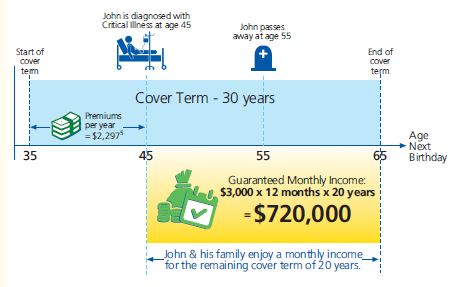
How MFC works is that you choose how much is the monthly benefit payout and the policy duration. Upon the occurrence of an unfortunate event, the policy will pay the monthly benefit for the remaining duration of the policy or 10 years, whichever is longer. An illustration of how it works is shown below.

How MyFamilyCover Works

In the example above, John enters into a policy that pays $3,000 per month for a duration of 30 years at age 35. At age 45, he is diagnosed with a critical illness. The policy will pay out $3,000 per month for the remaining duration of 20 years to him or his family. This helps the family to meet the daily expenses until say, the children have grown up and are able to earn an income to support the family.

There are 4 different flavours of the policy, as follows:
  • Plan 1 - Covers Death, Terminal Illness (TI), Total & Permanent Disability (TPD) and Critical Illness (CI)
  • Plan 2 - Covers Death, TI and TPD
  • Plan 3 - Covers Death and TI
  • Plan 4 - Covers TPD and CI
The policy that I bought is Plan 4. However, for ease of comparison with other traditional insurance policies, I will assume Plan 1 in the subsequent discussion.

As the total amount of payout reduces with time, it is quite similar to a reducing term insurance whose sum assured reduces with time, like the loan principal of a mortage loan. How does MFC compare with a reducing term insurance? The following assumptions are used:

MyFamilyCover
Monthly Cover  $         3,000
No. of Years 30


Reducing Term Insurance
Total Cover  $  1,000,000
No. of Years 30
Interest Rate 5.0%

The reduction in total payout for both MFC and Reducing Term is shown below.

Total Payout for MFC and Reducing Term Insurance Over Time

As shown in the figure above, the total payout for MFC drops faster than Reducing Term as Reducing Term has an interest rate of 5%. The difference reaches $145,000 by Year 18, after which the difference reduces over time. As MFC has a minimum payout duration of 10 years, the total payout remains constant at $360,000 from Year 20 onwards while that for Reducing Term continues to drop. From Year 24 onwards, the sum assured for MFC is higher than that for Reducing Term.

Why did I choose MFC over a more traditional Reducing Term insurance, even though Reducing Term has a higher payout than MFC for most of the policy duration? The key reason is because MFC pays out the benefits regularly whereas Reducing Term pays out the benefits in a lump sum, even though the lump sum may be higher. While the lump sum payout guarantees the amount of payout received, it does not guarantee how much money could be spent monthly to meet daily expenses or how long the money could last. In contrast, for MFC, both the amount that could be spent monthly and how long the money could last are known. Considering a typical family in which the spouse might not be financially savvy, the parents are old and the children are young, a known regular payout for a known duration provides much greater assurance to the family than a known lump sum payout but unknown draw-down amount and unknown duration. Not everyone is financially savvy to be able to manage a lump sum payout. If the family unwittingly invests the lump sum payout into some risky investments in their attempt to stretch the duration which the money could last, it could put the financial sustainability of the family at risk. For the above reason, I have always preferred a regular payout insurance over a lump sum payout insurance. It is good that Aviva has understood the need and came up with an innovative insurance policy that addresses the needs more precisely. I hope more insurers would do the same.

There is currently a 20% discount on all future premiums on MFC. The promotion will end on 31 Jul. So, if you are interested, do hurry. You can contact Aviva on their website (give 2 days for them to call you back). Alternatively, I can refer you to the insurance agent whom I bought MFC from by leaving your contact info here. In the meanwhile, you can check the MFC brochure on Aviva website and the annual premiums on compareFIRST.sg.

By the way, when you meet the insurance agent, please let them know that you found out about MFC on compareFIRST, so that insurers can place more of their insurance products on it for comparison.


See related blog posts:

Sunday, 5 July 2015

Stretch Loan & Invest the Rest

You probably have heard of the phrase "buy term and invest the rest". It means to buy a term insurance instead of a whole life insurance and use the savings in insurance premiums for investment. Can this advice be applied to loans as well? Meaning, instead of paying off your loan over a short period of time, you stretch your loan over a longer period and use the reduction in loan repayments for investment.

Let us consider the following scenarios:

Loan
Loan Principal
 $400,000
Loan Interest Rate 2.60%
Loan Tenure (Short) 15 years
Loan Tenure (Long) 30 years
Yearly payment (Short)
 $  32,545
Yearly payment (Long)
 $  19,367


Investment
Yearly Available Sum
 $  32,545
Yearly Rate of Return 7.00%

The loan principal is $400,000. You have a sum of $32,545 yearly which can be used to either service the loan or invest in a portfolio of stocks and bonds. The loan interest rate is 2.6% while a balanced portfolio of 50% stocks and 50% bonds can return 7.0% each year on average. You can choose a short loan tenure of 15 years, in which you will pay off the loan in 15 years, after which you can channel all the money to investment for the next 15 years. Alternatively, you can choose a long loan tenure of 30 years, in which you channel $19,367 to service the loan and the remaining $13,178 to investment every year for 30 years. Which option would be better for you? The figure below shows the loan and investment amount for the 2 options.

Loan & Investment Amount for 2 Loan Tenures

As discussed earlier, the shorter loan gets paid off earlier by Year 15, whereas the longer loan is only paid off after Year 30. However, the investment amount only grows to $818,000 at Year 30 for the shorter loan option, compared to $1.24 million for the longer loan option. In terms of the total loan interest payable, the shorter loan incurs a smaller interest of $88,000 whereas the longer loan incurs a larger interest of $181,000, which is nearly $100,000 more than the shorter loan. This means that there is nearly $100,000 less available for investment. Yet, due to the longer period of compounding, the longer loan option is able to generate $849,000 in investment gains, as compared to $330,000 for the shorter loan option. This example shows that the time period available for the investment to compound can be more important than the amount of money available for investment.

From another perspective, the servicing of loan can be considered a form of investment. The "return" from this "investment" is the loan interest rate, which at 2.6% is lower than the 7.0% return available from the balanced portfolio of stocks and bonds. Hence, it is more beneficial to channel most of the money to the investment with higher returns, which is the balanced portfolio. Conversely, if the rate of return from the balanced portfolio is lower than the loan interest rate, then it is better to channel most of the money to pay off the loan as soon as possible. In essence, loans and investments are 2 sides of the same coin and should be assessed in the same manner.

Sunday, 28 June 2015

Why Singapore Interest Rates Might Rise Faster than Expected

Beginning this year, a friend asked me what I thought about interest rates. My reply was it should not exceed 1% this year and 2% next year. Of course, I was referring to the US federal fund rate instead of Singapore housing loan rates. Still, when the Singapore Interbank Offered Rate (SIBOR) shot up to 1% in Mar, I was quite surprised. Now, I think I know the reason why.

Before explaining the reason, let us first understand the basics of Singapore housing loan rates. There are 2 ways of getting a SGD loan. The first and most straightforward way is to borrow in SGD and repay in SGD. This is the basis for SIBOR loans. The bank that loans you the money will borrow from other local banks at the SIBOR rate and loan you the money with a spread above SIBOR, e.g. SIBOR + 0.75%. The alternative way is to borrow in a foreign currency, say, USD and convert it into SGD. When the loan is due, convert the repayment from SGD into USD and settle the loan which is actually denominated in USD. This is the basis for Swap Offer Rate (SOR) loans. The bank that loans you the money will do the borrowing in USD and conversion into SGD (and the reverse path) for you, so you will only see the middle portion in which you borrow from and repay to the bank in SGD. As there is conversion between currencies, there is forex risk involved in such loans. If USD were to rise against SGD when the loan is due, more SGD is needed to repay the USD-denominated loan. The bank will hedge this currency risk at the point of initiating the USD-denominated loan by buying USD in advance through a currency forward. The cost of converting between the currencies is included into the interest rate known as SOR. Thus, SOR includes the USD interest rate and a currency factor. The general formula for computing SOR is as follow:


The precise formula for computing SOR, which takes into account different loan tenures, by the Association of Banks in Singapore can be found in this link.

Usually, the tenure of the USD-denominated loan is a short one, ranging from 1 month to 6 months. At the end of the loan tenure, the bank will repay the original loan and initiate a new loan at new interest rate and new currency forward rate, so the roll-over is transparent to borrowers. The term 1-/ 3- /6-month SOR refers to the tenure of the USD-denominated loan and reflects how frequently the SOR will vary. Generally, the SOR for longer tenure will be higher than that for shorter tenure, to reflect the greater uncertainty in credit risks and forex rates. Also, since forex rates are volatile, SOR tends to be more volatile than SIBOR and the shorter the tenure, the more volatile is the SOR.

While it appears that SIBOR is not affected by forex rates, capital flows freely in and out of Singapore. Just as a Singapore borrower can borrow money in USD, a US borrower can also borrow money in SGD at SIBOR-pegged rate and convert to USD if SIBOR is much lower than SOR. Eventually, both SIBOR and SOR must converge for capital flows to be in equilibrium. Thus, both SIBOR and SOR will move in tandem with each other.

Having understood the workings of SIBOR and SOR, we can go on and discuss the recent movement of SIBOR and SOR. Since SOR is directly affected by forex rates, a rising USD against SGD will lead to higher SOR (and SIBOR). The figure below shows the movement of USD against SGD (orange line) since mid last year. 

USD Movement against SGD (orange line)

As shown in the figure, USD has risen by nearly 7% against SGD, with a small spike in Mar. This coincided with the spike in SOR and SIBOR in Mar. USD has since retreated slightly, which is again reflected in the slightly lower SOR and SIBOR after Mar. See the figure below from HousingLoanSG.com on SOR and SIBOR movements.

SIBOR/SOR Rate Movements

Moving forward, USD is likely to keep on rising against major international currencies as discussed in Getting Ready for US Interest Rate Rises. On the other hand, SGD cannot rise too much against regional currencies to avoid losing competitiveness. This means that SIBOR and SOR are likely to rise faster than the US federal funds rate. Add on to the fact that the federal funds rate is likely to start increasing in Sep or Dec, it can only mean that SIBOR and SOR will rise further.


Sunday, 21 June 2015

Getting Ready for US Interest Rate Rises

After talking about it for 2 years, the US Federal Reserves (Fed) is finally about to raise interest rates. For a good part of these 2 years, I had not been too concerned about interest rate rises and was happy to pick up REITs beaten down by interest rate worries. It was 2 weeks ago that I realised that while interest rate rises were not too worrisome, things do not work in isolation. Here are my thoughts and actions taken in response to interest rate rises and their secondary effects.

Wave 1: US Interest Rate Rises

As mentioned, interest rate rises should not be too worrisome. My guess is that US interest rate should not rise to more than 0.75% by the end of this year and 2% by the end of next year. By pre-Global Financial Crisis standards, 2% interest rate is considered very low. Thus, I am not too concerned over the increased interest that stocks and REITs have to pay on their debt obligations.

Wave 2: US Dollar Rises

When US interest rate rises, US Dollar will become more attractive and rise as well. In fact, this has already happened. Since the middle of last year, US Dollar has started to rise against Singapore Dollar, Euro and Yen. The rise is approximately 7% against SGD and 20% against both EUR and JPY.

USD Movement Against SGD, EUR & JPY

Considering that Japan is in the middle of its Quantitative Easing (QE) at a rate of 80 trillion yen (equivalent to USD650 billion) per year and Europe has just started its QE in Mar this year for a total of EUR1.1 trillion, it suggests that USD will continue to rise. Essentially, the more money that Europe and Japan inject into their respective economies, the more money is available to invest in US assets. Both the World Bank and International Monetary Fund (IMF) have in recent weeks advised US Fed to defer its interest rate rises until next year. Should USD continue to rise due to interest rate increases, it would hurt the competitiveness of US manufacturers and might force Fed to reverse course and lower interest rates again.

Among the regional currencies, SGD is usually the strongest. Against USD, Malaysian Ringgit (MYR) has fallen by 16% and Indonesian Rupiah (IDR) has fallen by 11% since a year ago, as shown in the figure below.

USD Movement Against SGD, MYR & IDR

The effects of the above foreign exchange movements mean that companies that earn revenue in USD will benefit, while those that earn revenue in EUR, JPY, MYR and IDR will suffer. Among the stocks in my portfolio as at end May, LippoMalls earn its revenue in IDR while its debts are denominated in SGD. Metro also has retail operations in Indonesia. Both were sold in early Jun. For more details on LippoMalls, you can refer to A Tale of 2 Indonesian REITs.

The strengthening of SGD against regional currencies also means that it has become more expensive to visit Singapore for holidays, leading to lower revenue for hotel business trusts such as CDLHTrust, FarEastHTrust and OUEHT. All 3 were sold in early Jun.

There is another stock that is based in Indonesia, namely First Resources. However, it earns its revenue in USD, so there is not much concern. It is possible to understand the impact of foreign exchange movements on companies' earnings by referring to their annual reports. There is usually a section that discusses the impact to earnings and equity if the major currencies that the company is exposed to rise or fall by a certain percentage.

Wave 3: US Dollar-Denominated Assets Fall

When USD rises, assets that are denominated in USD tend to fall. Such assets include gold and oil. As at end May, I have about 8 oil-related stocks in my portfolio, such as BakerTech, CH Offshore, ChinaAvOil, CSE Global, Keppel Corp, MTQ, PEC and Rotary. None of them will be sold for 2 reasons. Firstly, oil prices had already fallen by almost half since the middle last year! Going forward, it is unlikely that oil price will fall by a similar extent even if USD were to rise further. Secondly and more importantly, none of these 8 stocks carry a lot of debt. The highest debt/equity ratio among the 8 stocks is 50%. Hence, no massive rights issues are expected from these 8 stocks going forward.

I also have Lyxor Commodity that has exposure to both gold and oil. But it is sitting on paper losses and I gave up hope on this stock (for now).

Wave 4: Stock Market Volatility Rises

With so many effects happening, the stock market may become more volatile. Even if a company has very little debt, foreign currencies and exposure to gold and oil, its stock price may still fall in tandem with the general market. While there are trailing stops to protect the paper gains on some of the stocks, I generally do not expect many stocks to be sold on this ground. The key reason is as long-term investors, we should be more concerned over the economics of the company rather than the short-term volatility of the stock price. A company can lose money if it has a lot of debt, foreign currencies and/or exposure to gold and oil, but it cannot lose money because the stock market is volatile (unless it is a financial company). Hence, not many stocks will be sold on this ground. On the contrary, I will be waiting at the sidelines to pick up good-quality stocks if they were to be beaten down.

On the Passive Side

There are a lot of things happening on the active side of investments. However, on the passive side, all the above effects can be considered as noise. It is business-as-usual for passive investment strategies like Dollar Cost Averaging and portfolio re-balancing. They have in-built defence mechanisms to handle any volatility in the stock market. You may wish to refer to The Anti-Fragile Portfolios for more info.


See related blog posts: